Reflections on Going Through the Ice
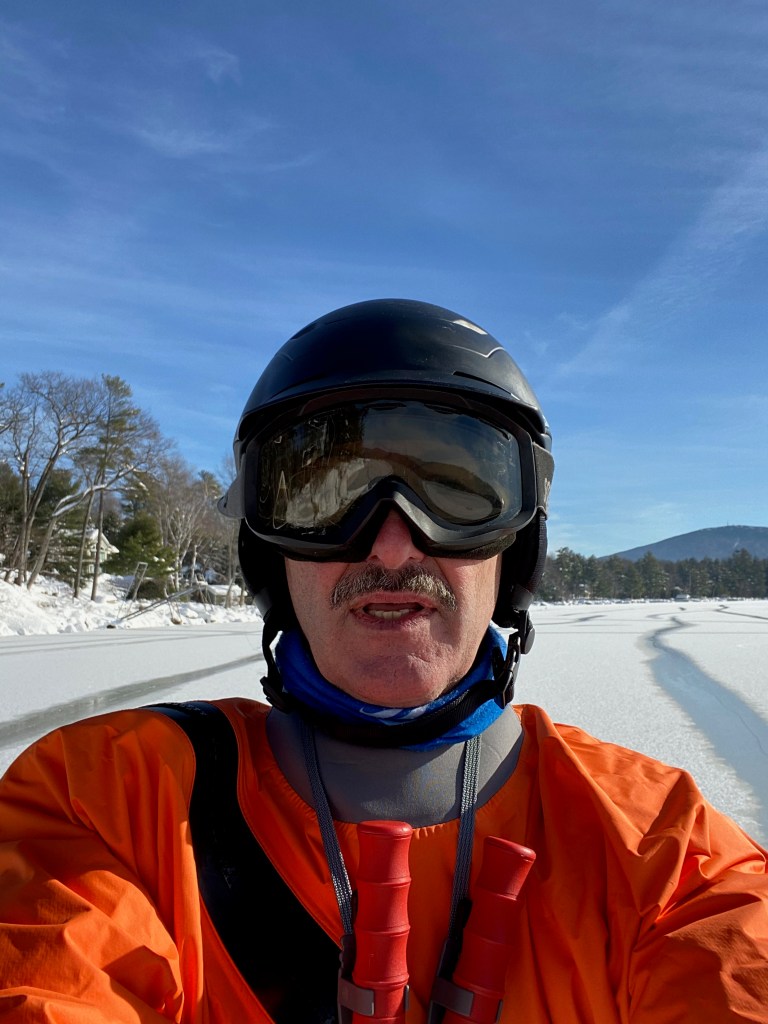
When I learned to ride a horse as a boy I was told, “There are two kinds of horsemen, those who have fallen and those who are going to fall.”
I suppose one might say the same of ice boaters.
When I started ice boating 40 years ago on a “cheap skate”, I used to carry two Phillips screwdrivers attached by a thin line run thru the sleeves of my parka. I never had occasion to use them, but they were there.
More recently when I started Nordic skating and purchased a DN, I bought a pair of more upscale “ice-claws” that hang around my neck on a plastic holder. Last season after a “wake- up call” on Newfound Lake (sailing towards open water at 30 knots) I bought a dry suit and started wearing it out on the ice.
I am comfortable in the water, a strong swimmer and confident sailor, but having jumped into 34-degree water once (intentionally) I recognized the danger.
Today on Lake Winnipesaukee I went through the ice not once, but twice. The first time was in a trench where one ice plate was subducting beneath another and the surface looked sound, but the boat broke through. Thanks to the drysuit there was no submersion shock of hitting the freezing water.
To my pleasant surprise, my DN floats, though I know most DNs do not. I crawled /swam over the top of the floating hull to the edge of the ice. I was actually quite buoyant in the drysuit. Once there I was confronted by a 45degree angled sheet of slippery wet ice that I could not surmount. Out came the ice picks and I clawed my way up the slippery slope, pulling a line that was attached to the mast (in anticipation of just such an incident).
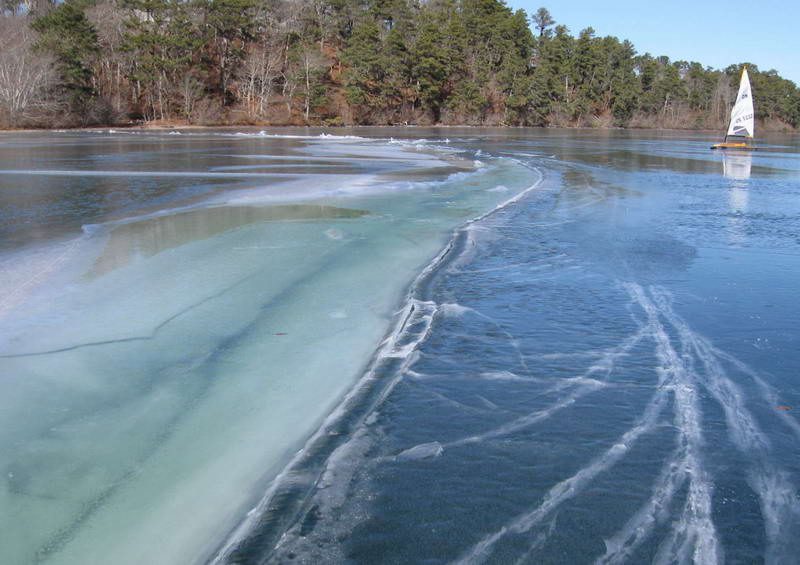
Not from incident but a great example from From Bob Dill’s http://lakeice.squarespace.com/pressure-ridges/
Classic downfolded ridge. Photo by Jeff Brown
Once up on the ice I was able to flag down a fellow ice-boater (Randy Rice) who helped me rescue the boat from the “drink”. Thanks to him and my attached line.
Eager to get back to the car, but feeling warm enough and not wet through (due to the dry suit), I headed back to the beach, but wandered off course and found another gap between two plates. Again the boat floated and I was able to get back up on the ice. As I tried to rescue the boat a second time I heard a high pitched cracking and realized the ice I was standing on was less than an inch. At that point, 200yds from shore and with no help in sight I abandoned the boat and walked ashore.
A homeowner was kind enough to drive me back to the launch point and my car.
“After action report”
The point of the story is not to embarrass myself, but to present a cautionary tale and encourage all my fellow ice enthusiasts to consider the merits of dry suit technology, and by all means, keep those ice picks handy.
I was moving slowly, scouting what I recognized as a sketchy situation, so there was no high-speed trauma. I climbed out of the water twice, was not cold, did not end up in the ER with hypothermia, was able to get back in my car and drive myself home.
I notified the people who were out on the ice and knew I had gone in before I went home, so that they would not undertake a search and rescue operation (they had already started looking for me). Luckily my phone was still working. I also notified the local police so that if the boat was discovered by anyone else they would not undertake a search and rescue mission.
Your fellow ice–boater,
Mark Friedman
DN3869