Hello All- This season ain’t done! This event was a big success last year and it looks like round two could be even better…..
Moosehead Lake is shaping up nicely for the weekend. Sunny with winds in the 20’s on Saturday, sun with winds in the teens Sunday. Reports from locals on the condition of the surface, along with web cam images, indicate it will be good enough. The rain falling today will hopefully drain out or evaporate before the temps plunge, reducing chances of shell ice forming.
The 100 mile race will start at 10:00 Sunday. Launch at The Birches, Rockwood, ME. The Birches has one cabin open for Friday, and a lodge room for both nights. Moose Mt. Inn has two rooms open for the weekend.
We will be on the ice Friday by noon and will post an update on conditions then.
Keep an eye on https://iceboat.me/ for info.
James “T” Thieler
12 Channing St.
Newport, RI 02840
401 258 6230
t_thieler
03/02/2017 | Categories: 2017 Season | Comments Off on CIBC CENTURY RACE THIS WEEKEND!
The Euro champs are done and the US group is back at Torsten Siems house to dry sails and pack up-
Regatta was good- good turnout, great lodging, phenomenal competition!
The Poles set the pace with Karol Jablonski taking top spot by only a point or so followed by a list of other Polish hot shots. Pretty impressive! See IDNIYRA Europe site for details and results.
Top American was Chris Berger of Chicago in 15th a few spots ahead of yours truly- Eben did us proud in silver!
Hope all well back home- Stay tuned! T
img 6773
img 6774
James “T” Thieler12 Channing St.
Newport, RI. 02840
401 258 6230
t_thieler
02/24/2017 | Categories: 2017 Season | Comments Off on DN Europeans Done
Hey Folks! Day one complete at DN European Champs. Challenging conditions (puffy breeze and soft ice) put a premium on keeping your head out of the boat and avoiding the calm spots.
My apologies for not including photos but my phone went for a swim…
The Poles have top three spots with with a few others scattered in. Yours truly just a point out of top ten right now but workin’ on it…. Honorary New Englander Chris Berger in 29th and Whitcomb sitting in 33rd in silver. Full results on DN Europe website.
A couple Videos added by the editor and borrowed from the IDNIYRA website. Thanks Deb!
Hope all well back home! Stay tuned…. T
02/20/2017 | Categories: 2017 Season, Racing | Comments Off on NEIYA News from European Championship Lake Balaton, Hungary
I received an email awhile back from a guy in NH interested in getting involved in the ice game- I threw his name and email address to a few people and checked in with him a few weeks later to see if he’d had any luck- what follows is his reply. Well done gang! Classic story….
Good morning James,
Thanks for the email and for following up. In short, yes, several people from NEIYA contacted me almost immediately after you sent out your email asking for assistance. Walt Colontuono (Windham NH) offered up an intro sail in his Arrow, which went very well. After a few laps around the lake with me in training, he generously offered me use of his Arrow for much of the afternoon (which was a great experience). A couple of other sailors offered the use of their DNs, which I didn’t find nearly as comfortable or relaxing. Long story short, that evening I found an Arrow for sale on-line, rented a Hertz SUV the next day, drove to Gary Indiana, and returned the following day with a very well kept Arrow on the rooftop (see attached photo) and 1900 miles on the odometer (should have seen the Hertz guy’s face when I checked it back in). I only had a few minor items to fix up (frayed halyard needed replacing) and I’ve been out on the ice a couple of times already. Another reason to love winter in New England!
Thank you so much for putting me in contact with these folk–great group of folks.
Jim
02/17/2017 | Categories: 2017 Season | Comments Off on Another In The Fleet!
Hey Folks-
An elite group (Whitcomb and Thieler, can’t get much more elite than two people!) headed to Germany yesterday to compete in the European DN champs.
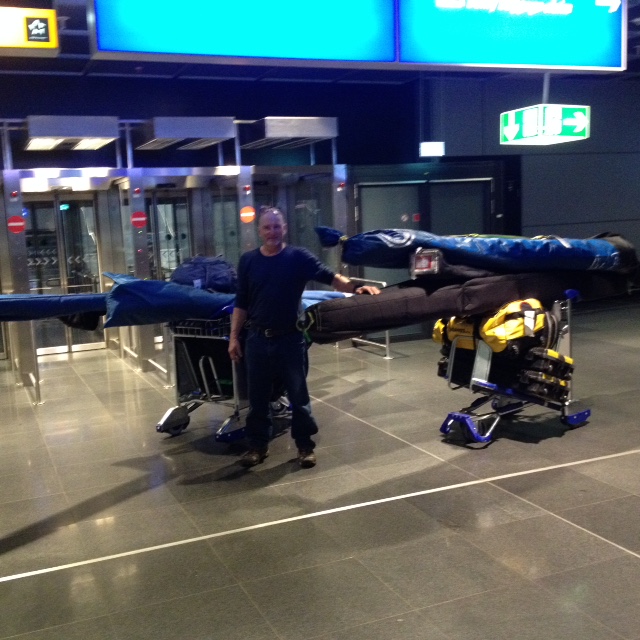
So far so good- all equipment arrived without delay or damage (see photo of Eben w boats at airport) and we were upgraded from economy to business class for the flight free of charge. Business class is amazing. Seats that recline to horizontal, nice blankets, fluffy pillows, great food…. Fantastic.
But back to earth now. Looks like we will be driving to Sweden for the races but no official call yet. Stay tuned for bulletins!
Hope plenty of sailing going on in NE. Central Lakes champs called on for the weekend, see IDNIYRA site for details.
Think Ice! T
02/17/2017 | Categories: 2017 Season | Comments Off on DN Euro Champs
Hold your horses. The Canadians have reviewed their call and changed their minds. No regatta this weekend.
Sounds like you might be able to sail Missisquoi Bay Saturday but it will be fairly rough and there is a fair amount of snow in the forecast for Sunday.
02/10/2017 | Categories: 2017 Season | Comments Off on Canadians Called OFF
NOTICE OF RACE
Canadian DN Championship Regatta
February 11-12, 2017
Canadian Region IDNIYRA
Organizing Authority
International DN Ice Yacht Racing Association
Canadian Region
1. Rules:
All races will be governed by the Racing Rules of the National Iceboat Authority; the By-Laws of the IDNIYRA, and Official Specifications of the DN Ice Yacht; the Notice of Race, including any amendments to the Notice of Race, (except as any of these are altered by the sailing instructions) and the Sailing Instructions. The Sailing Instructions can be modified at the Skippers Meeting and by a notice posted on the official notice board.
Nine race regatta format – 3 race minimum will constitute the regatta. One fleet is anticipated, but if a gold/silver split is required it will first be based on IDNIYRA rankings, with assignment by race committee thereafter. Discard race after 6 races sailed.
2. Eligibility:
All DN class yachts meeting the requirements of the Official Specifications and whose skippers meet the requirements of the By-Laws of the IDNIYRA as stated in the section IDNIYRA Regattas are eligible to enter and race in the championship.
3. Site Information and Postings:
A. The primary site is Philipsburg, Quebec
B. Site and Headquarters Information will be determined by the regatta organizer.
C. Official regatta information, updates and accommodations: see http://dnamerica.org/forum/index.php?board=11.0
4. Entry and Fee:
Register in the pits Saturday morning
$20 registration fee (Canadian or US funds accepted at par)
5. Schedule of Events:
•Sat 10- 11am on ice registration
•Sat 11am Skippers Meeting
•Sat 11:30 am First start
•Sunday 10:00am First start. No race will start after 3PM
6. Sailing instructions
Official Sailing Instructions will be provided at registration.
7. Prizes
There is a perpetual trophy for 1st place.
8. Proof of Insurance
Proof of personal or race liability insurance ($300,000 minimum)
Sailing Instructions
Canadian DN Championship Regatta
February 11-12, 2017
Canadian Region IDNIYRA
1. The Race Course will be three laps of the National Iceboat Authority INLINE Course. Marks will be orange tetrahedrons; the Darling marks will be smaller than the Windward and Leeward marks.
2. The first race of the day will start at 11:00AM on Saturday, and at 10:00AM on Sunday. Subsequent races each day will start as soon as possible after starting positions are available, but a yacht shall not be required to start sooner than 15 minutes after finishing. No race will be started after 3:00PM on Sunday.
3. A rope or wire starting line may be used: DO NOT SAIL OVER THE LINE! Each yacht’s leeward runner shall be positioned at her starting number.
4. The starting signal shall be the rapid lowering of the starter’s arms (or flag) after he/she raises his arms (or Code Flag ‘N’) to signify the preparatory signal. If the start is to be delayed after the preparatory signal, the starter will slowly lower his arms (or flag).
4. The finish of the first boat will be indicated by the display of a flag at the leeward end of the finish line. When a flag is so displayed the Bart rule is in effect. The flag will be displayed until all yachts have finished or the time limit has expired, whichever is sooner.
5. The time limit for the first finisher in a race is 6 ½ minutes per mile of rhumb line course length (e.g., for a 1 mile course, 3 laps x 2 legs per lap x 6 ½ minutes = 39 minutes). Any yacht not finishing within 20 minutes of the first yacht shall be scored DNF.
6. There will be a maximum of nine races, with three races required to constitute a series. There will be one discard if six or more races are completed.
7. Intention to protest must be reported to the race committee immediately after the race in question. A written protest must be filed with the race committee or the Canadian Rear Commodore at the launch site within two hours of the finish of the last race of the day.
02/10/2017 | Categories: 2017 Season | Comments Off on CANADIAN DN CHAMPS NOR / SI’s
The 2017 Eastern Regional Championship is postponed until further notice due to snow and possible drifting. In better news our good neighbors to the north have 3 locations that are being evaluated for the Canadian Regional Championship to be announced hopefully before 2pm friday. Pack your passports and lets get ready to go Fast and Turn left!!
These Sites are:
Trenton, Ont
Kingston,Ont
Phillipsburg, Que.
Best, Chad Atkins
DN US 4487
Eastern Regional Commodore
catkins4487
02/09/2017 | Categories: 2017 Season | Comments Off on Easterns Postponed. Canadians?
Don’t schedule anything for the weekend just yet. Our Eastern region rear commodore Chad Atkins is hopping to pull off a miracle and find some ice to host the Eastern Regional Championships this weekend. The weather is going to make it hard but keep the faith.
Oliver
02/08/2017 | Categories: 2017 Season | Comments Off on Easterns Hopefully
Things didn’t pan out as we hoped north of the border. One spot had hard snow drifts and the other only had 2.75 to 3 inches of ice so unfortunately our border run plans are dashed.
Next time.
It sounds like the Maine guys might have some ice but as far as I know there is nothing in Vermont or New Hampshire.
Oliver
02/03/2017 | Categories: 2017 Season | Comments Off on No Go on Montreal
NOTICE OF RACEEastern Lakes Regional DN Championship Regatta
February 11-12 2017
North American Eastern Region
Organizing Authority
International DN Ice Yacht Racing Association
North American Eastern Region
1. Rules:
All races will be governed by the Racing Rules of the National Iceboat Authority; the By-Laws of the IDNIYRA, and Official Specifications of the DN Ice Yacht; the Notice of Race, including any amendments to the Notice of Race, (except as any of these are altered by the sailing instructions) and the Sailing Instructions. The Sailing Instructions can be modified at the Skippers Meeting and by a notice posted on the official notice board.
Sail number does not need to match fuselage number or skippers registered IDNIYRA number but does need to be unique to each skippers sail (no duplicates on course)
-Skipper still needs to be a current member of IDNIYRA in good standing
Nine race per fleet – 3 race minimum in the Gold Fleet will constitute the regatta. Fleets – Gold and possible Silver Fleet/ Plate Runner Division/Rookie Division, Volunteer split for fleets if needed. Discard race after 6 races sailed.
2. Eligibility:
All DN class yachts meeting the requirements of the Official Specifications and whose skippers meet the requirements of the By-Laws of the IDNIYRA as stated in the section IDNIYRA Regattas are eligible to enter and race in the championship.
3. Site Information and Postings:
A. The primary site is within the North American Eastern Region
B. Site and Headquarters Information will be determined by the regatta organizer.
C. Official regatta information, updates and accommodations: dnamerica.org, theneiya.org
4. Entry and Fee:
Register in the pits saturday morning
$30 registration fee
5. Schedule of Events:
•Sat 9:15-10am on ice registration
•Sat 10am Skippers Meeting
•Sat 11am First start
•Sunday 10:00am First start. No race will start after 3PM
6. Sailing instructions
Official Sailing Instructions will be provided at registration.
7. Prizes
We are trying to locate any and all trophies for this event.
8. Proof of Insurance
Proof of personal or race liability insurance ($300,000 minimum)
While we wait here or choose to travel across the northern border here are a few words of wisdom pilfered from the Chickawaukie Ice Boat Club website http://iceboat.me
Lloyd Roberts wrote this some years ago for all our benefit. Please take a moment and read it. We need to know this stuff.
THINK ICE, SAFELY A PRIMER FOR THE NEW ICE SAILOR and A REVIEW FOR THE REST OF US
FORWARD
We use the term ice sailors to include the whole community of those who sail on the ice. There seem to be more non racers using the ice than racers and they are often using the same piece of ice at the same time along with the skaters, skate sailors, free skaters, bicycle riders and ice fishermen.
There is a general feeling that “touring” (non racing sailing) is more dangerous than racing. Racing takes place on a defined, explored, area of ice. The racers sail in a somewhat predictable manner with a common goal. The opportunities for collisions in races are numerous but generally avoided by awareness and adherence to ROW rules and self preservation instincts.
The rest of us are out for a sail on the ice. Our behavior is not so predictable and our goals vary. We may be new to the sport, or have a new craft and are trying to make it work. We may be wearing a GPS and trying to see how fast we can go. We may be actually touring, exploring the available ice. We often seem to be aimlessly reaching back and forth with no particular goal, just enjoying the unique kinesthetics of sailing on ice.
Ice sailing is inherently hazardous by nature but we all can reduce the chance of an adverse outcome with forethought, awareness (getting our eyes and minds “out of the boat”), and common sense.
Why do we do it? We do it because it is a unique and fascinating winter adventure.
RIGHT OF WAY
Safety in racing largely focuses on the ROW “rules”, different for ice racing than for soft water racing. “Right of Way” implies an imperial right and it is tempting, in the excitement of competition to use that “right” as a weapon to inconvenience rivals. Maybe water sailors do this but the high closing speeds and resulting compressed reaction time in ice racing make aggressive ROW use inadvisable.
The “Right of Way and Safety Requirements” drawn by the late Hal Chamberlain based on the National Iceboat Authority Rules are published periodically and should be familiar to experienced ice sailors. These are written especially for racers but should be familiar to and used by non racers as well. These customs are designed to prevent collision by providing predictable behavior patterns for ice sailors approaching or in proximity to other sailors. The emphasis of responsibility is on the “KEEP CLEAR” skipper. The “ROW” skipper has the initial responsibility of not altering course in a way that might confuse the “KEEP CLEAR” skipper. However “ROW” should not sail to destruction if “KEEP CLEAR” does not keep clear. Here is where aggressive sailing by “KEEP CLEAR” can be hazardous. Apparent aggressive sailing may of course be due to one or both skippers not seeing each other. The problems of visibility and perception are a common theme in any discussion of ice sailing safety.
The “Right of Way and Safety Requirements” follow at the end of this article. Feel free to print the graphic, laminate it, and keep it in your kit.
VISIBILITY, SEEING, AND PERCEPTION
Perception requires seeing and seeing requires visibility. In our less serious recent collision, during a race, the KEEP CLEAR did not see the ROW until about 8 feet away. His first thought was “what the hell is that” (perception problem) and they crashed without evasion time. ROW never saw KEEP CLEAR. Visibility from a DN in racing trim can be difficult and often the view is through the sail window which can be compromised by reflections. Are we suggesting going back to the ‘70’s sitting position in the DN? Not a bad idea for non racers, more comfortable too. Realistically, anything that slows down the racers is not going to happen.
Fogging of glasses, goggles and helmet visors is very dangerous and should not be tolerated. Spend whatever it takes, good goggles, vented helmet, contact lenses, etc.
Seeing requires looking. It is easy to gaze with rapture at the beauty of the sail and the antics of the tell tales or watch the ice boat beside you for some time as you creep past him. This is ice sailor’s attention deficit disorder, too long an attention span. “Keeping your eyes out of the boat” means looking around all the time, spending no more than a few seconds fixation on anything.
Despite looking you may not see a dark colored boat against a dark background, the sail may be edge on to you and not very visible. A bright colored boat may not show up against light ice in the sun. The European answer to this is fluorescent paint on the bow of the boat from mast step to bow, a very good idea. This helps peripheral vision detection and perception.
Perception is understanding what you are seeing (“what the hell is that?”), how what you are seeing may effect you, and what you should be doing about it. If at the moment you see a boat heading in your direction you also see a red stripe on your boom reminding you that you are on port tack and you are Captain KEEP CLEAR. You know it is your job to let ROW know you see him (wave, change course sufficiently) and you will miss him. If you are not racing you may be deep in ice reverie in ice heaven but you still have to periodically deal with other boats and all of the ROW customs apply.
HAZARDS OF TOURING
We have dragged home ice boat wreckage at least a half dozen times in the past 30 years, including many years of racing, but never from a racing accident. I have luckily never been really injured, just pretty sore a couple of times. Most non racing accidents are solo affairs (our recent fatality excluded). They are usually due to ice hazards, wind hazards (too much), or mechanical failure. Any ice big enough for touring in the literal sense of sight seeing is going to have hazards, guaranteed.
It is not smart to sail alone even on ice “known” to have no hazards. It is suicidal to sail alone on unknown ice or on big ice even though some of it has been recently sailed on. Other than a short trip out to the race course we use the buddy system. The buddy system means sticking together like glue with another ice boater and maintaining visual contact.
On a large lake a buddy system of four skippers is better. If something happens requiring help one skipper stays with the disabled party, the other two go for help. No one is alone.
Top speed is not necessary or desirable while touring (it is the trip, not how fast you cover the ice). Sit up, slow down, enjoy the scenery, keep an eye out for hazards and day dreaming tourers, again, eyes and mind out of the boat.
HAZARDS OF THE ICE
Ice, wonderful stuff, not only presents many patterns, colors and textures which give it character, but it may be too thin, reasonably thick but structurally unsafe, have holes in it for no apparent reason, be pressed together into ridges, pulled apart into open leads, or simply absent in unexpected places. Blessed is the lake covered with a uniform sheet of ice with no defects. This lake is usually small, you don’t need big ice for a big time.
Just as it is foolish to sail alone, it is almost as bad to come to a lake with boaters already on it and not inquire about hazards. If “there aren’t any”, don’t believe it, follow other boats until you get the lay of the ice. Still, use the buddy system. On a lake of any size if you have a problem and the sail comes down you disappear. You were sailing alone despite others on the ice.
New black ice usually does not cover the whole lake all at once. You can have nice 3 ½ inch thick ice transition to 1 ½ inch thick without any clue on the surface as seen from the ice boat. Snow drifts on new ice may insulate it so the ice under the drift is dangerously thin. Snow covered new ice is extremely dangerous.
Ice expands sideways as it freezes until it buckles into wrinkles called pressure ridges or reefs. These are always dangerous as one edge over rides the other often breaking it into small pieces that will not support you or your boat. Usually a ridge can be crossed somewhere after exploration on foot. Never sail across a pressure ridge no matter how benign looking unless you have just seen someone else do it right in front of you, and even then use caution. Be aware that pressure ridges may change from safe to unsafe in minutes. When in doubt get out, park, and explore on foot. Sometimes “pressure ridges” pull apart, these open leads are especially treacherous, even if you “know where it is”.
Many lakes have areas where, year after year, there are open spots, maybe way out away from shore. Local knowledge is very important and is the reason we tend to sail the same lakes season after season.
Frequently there is thin ice near points, islands, and shallow spots (like launch ramps) due to local solar warming of shallow water. These also tend to repeat year after year. Streams entering or leaving can be counted on to have thin ice near the mouth. Likewise but not so obvious, narrows between islands can have currents that undermine the ice.
Navigational buoys usually mean shallow water, beware.
We sometimes sail on larger lakes with large areas of open water (we would rather not). Be wary not only of the visible water but also the likelihood of open leads extending away from the open water. These can be sneaky because your attention is drawn to the open water and you do not look in front of you.
A nice sheet of ice on a large lake with a lot of open water may blow away from the land and then break up or it may break up from on shore wind and wave action. Local knowledge is vital.
THE VIRTUE OF SAILING AROUND BOUYS
Some feel that racing is what iceboating is all about and spend all their time doing it, going around little red buoys like moths around a candle. Racing is very exciting, highly addicting, and the only way to learn how to sail an ice boat well. Get advice and coaching from the faster skippers, they will be happy to help you. If you have questions about ROW, ask. DN racing has gotten very serious, sophisticated, expensive, time consuming, and rather daunting to the new ice sailor who often states “I just want to sail”. OK, but that sailor will probably never learn to sail down wind in light air, which always seems where the launch area is at the end of the day. Informal racing is the key here, you don’t even need to think racing, just put out a couple of traffic cones for windward and leeward marks and sail around them. Lacking cones use fishing houses (with respect for tip ups and people. If you hit a tip up, stop immediately and re-emburse the fisherman.) The important thing is to break out of the easy pattern of just reaching back and forth all the time. It takes at least a season to get the hang of sailing down wind. Some never get it.
PERSONAL SAFETY
SPIKES: You have to have traction. Spiked track shoes are the ultimate in traction and lack of warmth. Golf shoes are warmer. Insulated boots with ice fisherman strap on things (“DeIcers” recommended) are warmest and OK on clean ice, they are not so good in snow.
HELMETS: You absolutely need a helmet. Years ago we saw an iceboater while wearing spikes slip, fall, and lay his scalp open. Another, not wearing spikes, slipped just standing still and knocked himself out. Ice is harder than the hardest of hard heads.
The “Joffa” skiing helmets are very popular with the racers because they are very light which is vital for the recumbent DN racers and the face opening is very wide for good visibility. The lack of weight is due to a relatively thin outer shell and skimpy shock absorbing padding. A Snell approved motorcycle helmet is designed for impact resistance at highway speeds with hard objects like ice boat parts and ice, not just packed snow on a ski slope. Yes, they are more expensive. What are you brains worth? The weight is not much of a problem if you are sitting up in a civilized manner in touring mode. If you race, build up your neck muscles (see Appendix; “Skipper Care”). A properly fitting helmet is nice and warm too. Buy your goggles at the same time so they fit the helmet.
ICE PICKS AND THROW ROPES: Most of us now carry a pair of handles with spikes in them on a string around our neck (these are commercially available or you can make your own with dowels and nails). These are for clawing your way up onto the ice if you go swimming. Wet ice is very slippery. You can also carry a throw rope in a small bag or on a small reel on your waist. This you can use to haul someone out of the water or get yourself hauled out by your buddy. Your main sheet may save a life.
CHANGE OF CLOTHES IN YOUR CAR: A complete change of warm clothes would be pretty nice if you get wet, wouldn’t it?
PHYSICAL CONDITION SAFETY: Ice boating is strenuous, especially carrying and setting up the boats, and particularly trying to get a boat out of a hole in the ice. It is annoying to find you cannot hold your head up after sailing a short time. It is really annoying to be laid up for a couple of weeks after throwing your back out lifting ice boats or their parts. Regular daily year round stretching and muscle tome exercises will prevent these problems. See “Skipper Care” in the appendix.
HYPOTHERMIA: It is easier to stay warm than to get warm. Overall hypothermia can happen, especially if you have been swimming. Get ashore and get warm. At least change out of the wet clothes, if really cold get into a tub or shower. If really really cold, like unable to stand or losing consciousness, get to a hospital, this is a medical emergency, do not even try to walk around, activity can kill you.
A face mask or full face enclosed helmet is a must for all but Spring sailing at above freezing temperatures. Hands and feet seem to present the most problems. Hands spend a lot of time pulling on the sheet which doesn’t help circulation. Snowmobile mitts and gloves would seem to be a good idea but most of them don’t do the job. The best arrangement in our experience is insulated deer, elk, or moose hide “choppers” (Cobella’s or LL Bean) mitts a size larger than you wear and an inner pair of thin but warm gloves that you can leave on when adjusting rigging, changing runners, setting up the boat etc. The XC skiers have some nice thin gloves with leather palms.
If wearing track shoes look for Gortex outer socks that keep the wind out and even stay dry when wading in puddles. Divers foam neoprene socks work well too. Again the shoes should be a size or two too big so you can wear a couple of layers of socks.
The ultimate anti cold weapon is the catalytic warmer envelope (iron and salt) which gives off heat for 6-7 hours. These are available at sport shops and often at gas stations in ice fishing country. They come in hand and toe patterns. They cost about $1.50 a pair, worth every penny. When it really gets cold these will keep your pinkies toasty warm all day, really.
IMMERSION (If you haven’t been swimming you probably will).
The U. S. Air Force requires all air crews to pass immersion drill exercises, it has been suggested that at first ice we should do the same, someone please organize this and lead the way. Not a bad idea, but I doubt we will get universal participation.
Anticipation and forethought should be almost as good as doing it. There has recently been a report from an immersion guru that once in the water you have about 10 minutes of consciousness and action before hypothermia gets you and you should spent the first minute getting used to the cold water, orienting yourself, and planning action. My personal experience and that of some others is that if you get out fast enough you don’t get totally sopping wet, a big plus.
The most common situation is sailing into a small spring hole or pulled apart pressure ridge you did not see. The ice boat tips over and often some part of it is on the ice for convenient climbing out. You may end up under the sail which can inspire panic. The ice at the edges of such defects is usually thick enough to support standing weight and often the boat can be extracted and sailed home promptly with due regard for the sheet freezing. This is easy: you go in, you get out, you get it out, you sail it home, you change and warm up. If the boat is damaged get someone else to sail you home and make sure you are dry and warmed. Let others take care of the wreck. If you were sailing alone you could be in big trouble. Apply warm fluids inside and out (bath, shower). It is important to be chaperoned in the post swim interval as hypothermia can rapidly lead to mental impairment and confusion unapparent to the wet person. Incoherence and inability to stand is a medical emergency, call 911, do not let the cold person try to warm up by attempting to walk etc. Get them out of wet clothes.
Sailing onto thin ice for some distance and breaking through is more complicated. It is important to get out, spread your weight out on the ice by not getting up, and claw your way back from whence you came on thicker ice. A moment or two for orientation is in order here. Extraction of the ice boat can be complicated needing ropes, boards, boats, etc. If an immersion suit is available and seems useful it should be used by someone familiar with its use, practice is needed, preferably in the summer. Preparation goes a long way here. Early and late in the season I often carry a 12 foot plank on the truck, usually used for getting on the ice at a thin edge. It would be very handy for thin ice rescue. A wind surfer hull with ping pong paddles, the paddles having spikes on the other end of the handle, is advised by Leo Healy and sounds pretty good. The NJ ice boaters have a tin “john” boat on retractable trailer wheels that is hauled to the ice by car and on the ice with an ATV. But the boat/trailer can haul all the regatta paraphernalia out to the race site including the wind break for the race committee, hot meals, lawn chairs, etc. More things to play with.
It is possible to get out of the water without ice claws by getting your body horizontal in the water and breast stroking up onto the ice. The late Larry Hardman did this easily (at 1 AM by moonlight and zero degrees), he says he just popped out onto the ice like a seal. The hard part was waking up the occupants of a nearby house who were astonished by the ice encrusted black snow mobile suit clad apparition. They took him in and plopped him a bath tub.
Skaters usually have warning they are on thin ice by cracking preceding break through. My experience (skating on known thin ice over thin water) is that a skate breaks through and trips you so you fall forward automatically distributing your weight over the ice. The skate has all your weight on a few square inches. The only problem here is your feet get wet and the laces freeze so you can’t get the skates off. A pocket knife plier combination tool works well here and is often handy for ice boating.
In summary, go in, think, get oriented, get out, get help, get dry, get warm.
02/02/2017 | Categories: 2017 Season | Comments Off on Words To Sail By From Lloyd
It sounds like our French speaking neighbors to the north might have some ice. The have walked it and are planning on sailing it tomorrow. So who would be interested in a casual regatta in Montreal on Saturday? Maybe the Montreal West Island Challenge?
This would not be an NEIYA event and we wont know if it is doable till mid day tomorrow, but it could be a fun weekend if it works out. Drive up Friday night, sail Saturday, treat the wife or girlfriend to a night on the town in a city where Trump isn’t president, sleep off the hangover and drive home in time to see the Super Bowl. Whats wrong with that? So if you are interested keep your schedules open and stay tuned.
Oliver
02/02/2017 | Categories: 2017 Season | Comments Off on Montreal anyone?
DN NA’s complete! Seven races in varying wind strength and sticky ice saw Ron Sherry break a mast tang in Race 1, put up a spare rig, and roll off four straight bullets and two other top five finishes to take the NA trophy. Very impressive demonstration! Well done Ron, congrats on being the current NA and European champ!
The Silver fleet was also given a lesson by a Sherry- Ron’s son Griffin took the top spot here- well done Griff!
Congrats to both- NE sailors had a tough time at NA regatta- I couldn’t find my wheels, chad was in a three way pile up of the start line and his boat got the worst of it and he had to retire, and so on down the line- So no great tales of victory from Gold Fleet….
In Silver we saw Steve Madden take 9th, so he is the hero of the day!
Regatta was a blast- for awhile it looked like it wasn’t gonna happen but at the last minute Derusha and Co found a spot and it was ON! Just goes to show you can’t play if you don’t show up.
Great time had by all and also really a treat to have so many of our friends from Europe sailing- Germany, Hungary, Poland, Sweden, Switzerland, Russia and Texas were all represented. Thanks for making the trip gang! Watching these top notch sailors duke it out at the pointy end of the fleet is impressive and humbling!
At least 20-25 sailors from the East made the trip- Smiles all around at the awards ceremony!
The road-trip aspect didn’t disappoint either; we found ourselves on the Canadian border on Inauguration Day (we saw a bald eagle flying north over the St Lawrence at about 12:15, wondered if that was an omen…. We report, you decide!), walked some cool lakes up there, ate some good food, stayed in some interesting places, and had lunch with a bomb disposal expert. Seriously. Never dull!!
Weather shut down a potential last day of the DN Gold Cup-
Good news is NEIYA represented well and will be bringing home some silverware- Check http://na.idniyra.org/2017worlds/ for results and have a look at the photos of Joerg Bohn and Jost Kolb minding the pickled eggs hat Derusha always brings and Steve Madden inspecting the underside of his baseball hat at the awards ceremony….
Off to scout ice or NA champs!
Stay tuned….
img 6682
img 6684
01/25/2017 | Categories: 2017 Season | Comments Off on DN Gold Cup Done





 New England Ice Yacht Association